
Why Framingham's Drop-Off Center Won't Take Your Construction Debris
The single most useful thing to understand about clearing a renovation in Framingham is that the City's drop-off center flatly won't take construction debris - and Massachusetts law bans it from ordinary disposal too.
In this guide
- What the drop-off center offers
- The residents-only, no-C&D catch
- The MassDEP disposal bans
- The DPW right-of-way permit
- How a roll-off fits in
If you are planning a remodel, a roof tear-off or a big cleanout in Framingham, there are two local realities worth understanding before you start - because together they decide how your debris leaves the property. Between a City drop-off center that refuses construction debris and the statewide MassDEP disposal bans, a real project's debris has to go to a licensed processing facility, by the load.
What the drop-off center offers
The City's Recycling Drop-Off Center on Mount Wayte Avenue is a genuine resource - for residents, for household recycling and trash. Framingham residents who receive city curbside service can buy an annual permit and use it several days a week.
But it is built for a household's own material, and it draws two hard lines that rule it out for a real project: no commercial vehicles, and no construction and demolition materials.
The residents-only, no-C&D catch
The City is explicit: the drop-off center does not accept construction and demolition materials - lumber, tile, concrete, windows and similar materials - and commercial vehicles are not permitted to dispose of trash there at all.
So the debris from a bathroom gut, a kitchen remodel, a torn-out deck or a roof tear-off is not something the drop-off center will handle, whether you bring it yourself or a contractor does. And curbside bulky pickup is capped at two items per collection, which a real project blows past immediately.
The MassDEP disposal bans
On top of that, Massachusetts has statewide waste-disposal bans enforced by MassDEP under 310 CMR 19.017. Asphalt pavement, brick, concrete, metal, wood and clean gypsum wallboard are all banned from disposal - they must be recycled or processed. Mattresses, textiles and yard waste are banned too.
MassDEP actively enforces this, fining C&D facilities that let banned material slip into disposal. So your renovation debris doesn't just need somewhere to go - it needs a licensed, MassDEP-permitted C&D processing facility that sorts those banned materials out for recycling.
The DPW right-of-way permit
Framingham's permit rule is simpler than some towns': a container on your own driveway generally needs no permit. It's only when the box has to sit on a public street or block a sidewalk that the City DPW requires a right-of-way permit - which takes a few business days and which we pull for you.
How a roll-off fits in
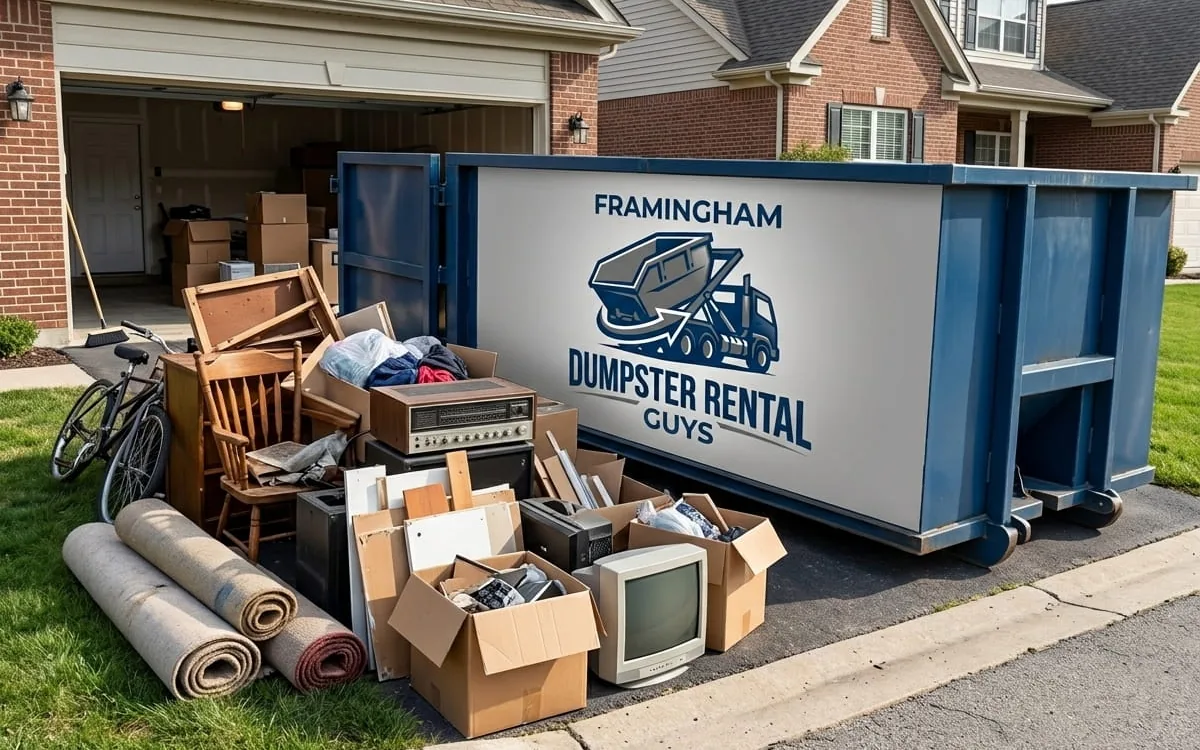
A roll-off dumpster is simply the bridge between your project and that licensed facility. We drop an open-top container on your driveway (or pull the street permit if it has to go on the road), you fill it at your own pace, and we haul it to the right processing facility - tarped and secured, as Massachusetts law requires. One flat price covers delivery, the rental period, collection and the disposal.
That is the whole answer to the drop-off center's limits and the disposal bans: you don't need either to take your renovation debris, because the container and the licensed facility handle it end to end. Tell us what the job is and we will size it, permit it if needed, and quote it flat.
Book a container in Framingham
One flat rate covering delivery, seven days, pickup and disposal.
(508) 665-2560Questions readers ask about this
Can the Framingham drop-off center take my renovation debris?
No. The City's Recycling Drop-Off Center is residents-only, bars commercial vehicles, and does not accept construction and demolition materials - lumber, tile, concrete, windows and the like. A renovation needs a roll-off to a licensed C&D processing facility.
What does Massachusetts ban from disposal?
Under 310 CMR 19.017, MassDEP bans asphalt, brick, concrete, metal, wood and clean gypsum wallboard, plus mattresses, textiles and yard waste. These must be recycled or processed at a licensed facility.
Do I need a dumpster permit in Framingham?
Not on your own driveway. Only a street or sidewalk placement needs a City DPW right-of-way permit, which we help secure before delivery.
Where does my debris go?
To a licensed, MassDEP-permitted C&D processing facility that sorts the banned materials for recycling, hauled tarped as state law requires, with the disposal built into one flat price.