
Junk Removal & Estate Cleanouts in Framingham, MA
Clearing a house is rarely a logistics job first. Much of the cleanout work we do involves a family sorting through decades of a life against a deadline - and the container needs to fit around that rather than the other way round.
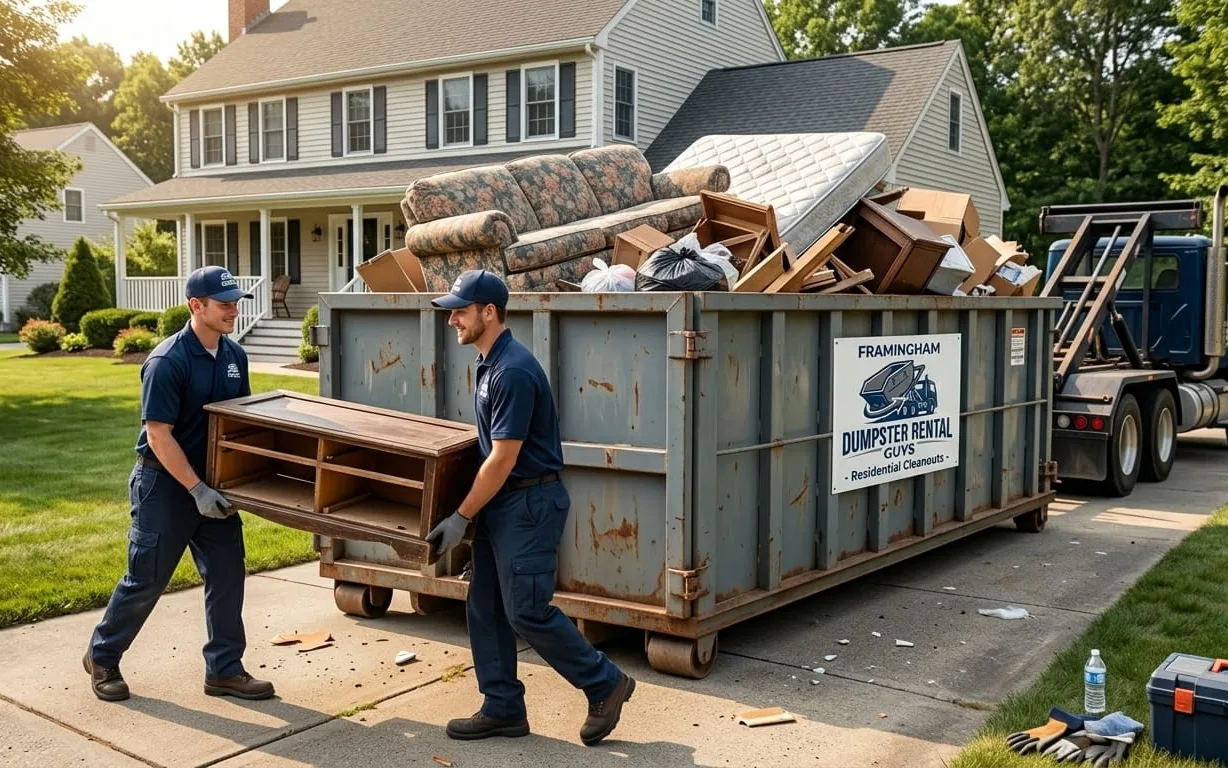
Why cleanout work needs a different rental structure
A standard short rental is the wrong shape for a house clearance. Families need to sort, and sorting rushed is sorting badly - people throw away things they later wish they had kept.
We set cleanouts up as extended rentals on a daily rate from the beginning, typically three to five weeks. The rate is agreed at the start so the invoice holds no surprises, and nobody from our office rings to chase the container.
Where the property is being sold or turned over, we work backward from the closing date so the place is clear with time to spare rather than on the morning itself.
The Massachusetts wrinkle
A house clearance is exactly the kind of job the municipal programs are not built for. The City's Recycling Drop-Off Center is residents-only and bars commercial vehicles, curbside bulk pickup is capped at two items per collection, and the MassDEP bans mean whole categories of what turns up can't go in ordinary disposal at all.
Mattresses and textiles are banned from disposal - a hauler legally can't put them in the trash - and so are metal, wood and the C&D materials from any remodeling mixed into the clearance. A whole-house or estate clearance therefore needs a roll-off that takes the bulk of it to a licensed processing facility, with the banned items pointed to the right recycler.
For a landlord turning over a rental or an executor clearing an estate, that single container on the driveway - kept as long as the sorting takes, with us handling any street permit - is the clean answer.
What can't go in - and where it goes
House clearances turn up material that can't go in a roll-off, and it's easier to know the list in advance. Old paint, solvents, motor oil, batteries and the like are household hazardous waste - prohibited from the container, and Framingham runs its own hazardous-waste collection events for them.
Under the Massachusetts bans, mattresses and textiles can't go in either - they route to a mattress recycler or textile drop-off. Electronics go to a drop-off site rather than the box. It's worth setting these aside before a garage or attic cleanout likely to turn them up.
Appliances are generally fine as scrap metal, though anything with refrigerant - old refrigerators, freezers, window AC units - should be flagged so it's handled correctly. Identify these early and set them aside, and we'll point you to the right route for each.
Sizing a house clearance honestly
Household contents are bulky rather than dense, which makes this one of the jobs where the larger container is usually correct. A fully furnished family home typically fills a 30 yard.
The exceptions are worth flagging when you call. If the clearance includes a deck or shed being torn out, plaster coming down, or a packed cellar, the weight climbs and a 20 yard swapped can work better than a single 30.
The larger lots and outbuildings common toward Sudbury, Sherborn and Southborough often have more to clear than the house suggests - sheds, barns, workshops, decades of accumulated equipment. For those we'd rather come and look than guess over the phone.
Where we provide this service
We deliver junk removal & estate cleanouts across Framingham and throughout Middlesex County, plus the surrounding MetroWest communities from Natick and Ashland to Marlborough, Sudbury, Hopkinton and the towns along the Mass Pike and Route 9.
Book junk removal & estate cleanouts in Framingham
One call gets you a flat rate, an honest size recommendation and a delivery slot.
(508) 665-2560Junk Removal & Estate Cleanouts: common questions
How long can I keep the container for a cleanout?
As long as the job needs. We set these up on a daily rate from the outset and three to five weeks is entirely normal. Nobody will ring to hurry you along.
Why can't I just use the city bulk pickup?
It's capped at two items per collection, the drop-off center is residents-only and bars commercial vehicles, and the MassDEP bans mean mattresses, textiles and C&D materials can't go in ordinary disposal. A whole-house clearance needs a roll-off to a licensed facility with the banned items routed correctly.
What has to be kept out of the container?
Household hazardous waste - paint, solvents, motor oil, batteries - is prohibited. Under the state bans, mattresses and textiles must go to a recycler, and electronics to a drop-off. Appliances with refrigerant should be flagged.
What size for a full home?
Usually a 30 yard, since household contents are bulky rather than dense. Tell us about a deck teardown, plaster coming down or a packed cellar, though, because that material is heavier and can change the answer.